Qoutes Why Does Family Ignore My Friend Request Am I That Horrible
Teens employ social networks for the creation and the maintenance of friendships. Most teens are using the networks to stay in touch on with people they already know, either friends that they encounter a lot (91% of social networking teens accept done this) or friends that they rarely see in person (82%).
Teens as well use the online networks to brand new friends; 49% of social network users (27% of online teens) say they use the networks to make new friends. Boys are more likely to report using the networks to make new friends than girls. Teens from middle and lower income families were more than probable to say that they employ the sites to make new friends than higher income teens. A bit more than than a third (37%) of teens from households earning more than $75,000 annually said they used social networks to make new friends, compared with 57% of teens from families earning less than $75,000 annually. Children of single parents were also much more than likely to use online social networks to find new friends than teens with married parents.
Teens told united states of america in their own words about how they use social network sites to make friends and communicate with people. For some teens it is how they make new friends "I like it. I but similar networking, that's about it," said one belatedly high school-aged boy. "…my school is pretty big, and so if I didn't know a person I can come across them through MySpace and but see them at school so. That's how I make friends, I guess." Another loftier school boy echoed his sentiments: "When you lot look at their contour yous get to see who they are and see if they might similar the same things you like. Y'all might like how they await or something like that." And for some teens, high schoolhouse-aged boys in detail, it is a way to meet and approach potential romantic partners. One high school boy said, "Yeah, like if you lot're just on in that location and you lot're looking through and y'all see a adept-looking girl on in that location and she wants to be my friend and y'all take!"
For some teens, making friends on social networks is less virtually finding common footing, and more about fugitive giving offense. Ane centre school-anile daughter told us "My friends will take friends that I don't know. Yous wait at them…Then you lot feel bad considering they're similar, 'Oh, well, I just saw you in this play, exist my friend.' And and then you're similar, 'Okay.' All right, y'all know, why not." Another middle school girl elaborated, "I mean, I'm not really making new friends, I'thousand merely not hurting peoples' feelings. If I know that they're friends with someone else that I don't feel like they're [going to] come up and set on me, and then it'south safe."
xvi% of teens are connected to "friends" on social networking sites who they take non met in person.
As the above quotes advise, some social networking teens study that their online friends are people that they take never met in person. One in half dozen or 17% of online teens and 31% of social networking teens have "friends" on their social networking profile who they have personally never met. More ii-thirds (69%) of social networking teens say they do non have unmet friends in their network. Older teen boys (ages fifteen-17) are much more likely than any other group to say that they have friends in their network who they have never met in person. Well-nigh one-half of social network-using older teen boys (47%) accept friends in their social network who they have never met. For older girls, just 28% report having people they have never met in their networks. About one in 3 (29%) of younger boys written report having friends they have never met, and just 22% of younger girls say the same.
Some un-met online friends are connected through other friends…
Out of the modest grouping of teens who have friends in their social networks who they have never met in person, many have friends who are in some way continued to an offline friend, and a smaller number have friends in their network who are in no manner connected to online or offline friends. 12% of online teens accept "friends" on social networking sites whom they take never met, only who have some connectedness to their offline friends.
"If people I don't know asking to be my friend I'll add them but I don't talk to them. I don't know why I add them if I don't talk to them, at present that I recollect near information technology. That'southward kind of stupid. Information technology just means they're on my friends list. I don't actually get anything out of it. They can just send me comments."
– Girl, Late High School
To wait at the data another way, 70% of social networking teens with un-met "friends" say some of these people have a connectedness to their offline friends – people like a chemical science partner's older sister, or the cousin of a good friend. It also could exist that these friends take simply been "friended" by some other friend of the social network user, and are in fact, true strangers with no offline connection. There are not statistically significant differences betwixt age groups and girls and boys with these kinds of online friends.
…Others have friends in their social networks that neither they nor their friends accept ever met.
A small subset of teens with unmet friends in their social network say that some of these friends have no connection to their online or offline friends. This grouping represents simply 9% of online teens and a bit more one-half (53%) of teens with un-met friends. All the same, the do of "friending" celebrities, musicians and political candidates in order to be affiliated with them in some way is a popular practice on social networks, and we exercise not know how many of these profiles account for links to unmet and unknown online "friends."
"i take a myspace and a xanga. most of the people i come across online are friends of friends of mine so i know they're really who they say they are and stuff. i think its really good. i got to know ane of my present best friends thanks to myspace."
– Girl, Tardily High Schoolhouse
Fifty-fifty though girls are less likely to have friends in their social network whom they have never met, those girls that do have unmet friends are more than likely than boys with un-met friends to say that these people take no connexion to online or offline acquaintances. Two-thirds (66%) of girls with united nations-met online friends say that they have social network friends who have no connectedness to any of their online or offline friends – 42% of boys with un-met friends say that at least some of their social networking friends are totally unconnected with other online or offline friends. Most of the difference betwixt boys and girls comes from the older girls (ages 15-17) in this grouping, of whom 72% say they have friends online who they have not met who are not continued to other online or offline friends. Just 39% of boys of the same age report these kinds of friends.
"I know when I get a friend request, if I don't know the person I won't automatically deny them, I'll become to their page and see who'due south in their pinnacle eight and see if I know any of their friends… They're not like strangers if your adept friend knows them, like they are to you, but it's not like they're dangerous."
– Girl, Middle School
32% of online teens accept been contacted online by a complete stranger. Contour-owning teens are much more likely to take been contacted.
In some cases teens are contacted online by consummate strangers, through social networks or other means of online advice like IM or email or in chat rooms. Out of online teens, nigh a tertiary (32%) have been contacted online past someone who was a complete stranger and who had no connection to whatever of their friends.
In our kickoff study of teen internet usage in 2000, we reported that 57% of parents were worried that strangers would contact their children online. At that time, close to 60% of teens had received an instant message or email from a stranger and 50% of teens who were using online communication tools said they had exchanged emails or instant messages with someone they had never met in person.
In our current study, online girls (39%) and older teens ages xv-17 (41%) were more than probable than boys or younger teens to have been contacted online past a stranger. Older girls were the virtually probable to report some kind of stranger contact, with half (51%) saying that they had been contacted online by someone unknown to them. Only 30% of older boys report similar stranger contact.
Social network-using teens are more than likely to have been contacted by a complete stranger than teens who exercise not utilise the networks; 43% of teens who use social networks have been contacted by a stranger online, while only 17% of teens who practice not utilize social networks accept had that experience. The data is similar for teens with online profiles – 44% of profile owners have been contacted online by a stranger, while only xvi% of those with out online profiles take been contacted by someone unknown to them or their friends.
However, as in the offline globe, stranger contact tin accept many forms. An unsolicited spam electronic mail message, instant message or comment from a stranger might be crusade for alert and distress or information technology may only become deleted or ignored by the teen. And some strangers who contact teens may, in fact, turn out to be agreeing peers in search of friends.
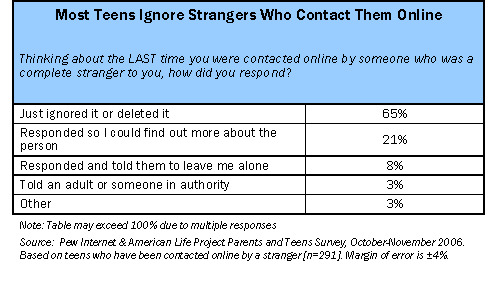
Most teens ignore or delete stranger contact and are not bothered by information technology.
Out of all the teens contacted online by strangers, the vast majority of them responded to the virtually recent occurrence by ignoring or deleting the contact. Near ii-thirds (65%) of teens who had been contacted by a stranger ignored or deleted the contact. Another 21% of contacted teens responded to the stranger so that they could detect out more almost the person. Older teens, and particularly older teen boys, were more likely to answer to the stranger contact with requests for more information to assess the level of threat posed by the communication.
"It gets weird. I think two weeks ago I got a request. And one of my friends hit approve. And the person, this guy started sending me weird comments…
And he'south sending me these comments like oh, y'all're and so hot, where do you alive? I want to meet you lot.
That gets a petty weird."– Girl, Late High Schoolhouse
Another 8% of teens who were contacted by people unknown to them responded to the most recent contact by responding and telling the writer to get out them lone. Just 3% of teens told an developed or someone in authority and another 3% took some other kind of action, including blocking the person from contacting them, or asking the individual to identify themselves with their real proper noun.
While profile-owning and social network-using teens are more likely to have been contacted online past strangers, their behavior in response to the stranger contact is not significantly different from online teens who practice not have a contour and who do non utilize social networks.
"yep ive had instant messages from random people i didnt know. i was really uncomfortable merely usually its a friends friend. and if its not i bs everything near myself or i just ignore them or block them all together."
– Girl, Late High Schoolhouse
seven% of online teens say they have been scared or uncomfortable subsequently being contacted by a stranger online.
Out of all the times online teens have been contacted by strangers, a relatively small percentage of the teens study ever feeling scared or uncomfortable. Teens who have been contacted online by people unknown to them typically say they have not felt scared or uncomfortable because of these contacts. Three-quarters (77%) of teens who have been contacted say they have never felt scared or uncomfortable, compared with 23% of contacted teens who take felt scared or uncomfortable later advice with a stranger. Looking at online teens as a whole, roughly 93% have never had the experience of being contacted online past a stranger in a way that made them feel scared or uncomfortable, while vii% take experienced this.
"My blood brother got into an online relationship with
a [older] girl. He told her where he lived and she
moved to [boondocks] the side by side week. She would
show up at our business firm. She followed me around.
'Where is your brother?'"– Girl, Early on High School
Girls are more likely than boys to report feeling scared or uncomfortable because of a stranger contact. Of girls who have been contacted online past someone unknown to them, 27% said they felt scared or uncomfortable, while only xv% of boys reported the same feelings. At that place is no significant difference betwixt historic period groups in reporting feeling scared or uncomfortable after stranger contact – about ane in 4 of teens contacted in either age group reported these feelings. Contour-owning teens are no more than likely than their counterparts to feel scared or uncomfortable because of contact from someone they practise not know.
Teens experience that they are more accessible to strangers when they are online.
Asked where they thought teens were nearly likely to exist approached past a stranger, the bulk of online teens believed that people their age were nigh likely to exist approached by strangers online rather than offline. Nearly iii-quarters (73%) of online teens believe that someone their age is almost likely to be approached by a someone unknown to them online, while 23% of online teens believe it is more likely to take identify offline. Another three percent of teens think it happens with equal frequency online or offline. Teens nowadays a unified front on this question, with niggling variation between boys, girls, age groups or between teens with online profiles and those without them.
"My cousin met this guy. He seemed nice. He said he was sixteen and went to a military machine academy. He gave my cousin his cell phone number. I think he did that so he could become hers. She called him. He actually was 16. When she called him he got all her information. He got her phone number and kept on calling her."
– Daughter, Early Loftier Schol
Teens announced to be acting on the awareness that they are more accessible to outside contact when they are online. For the most part, the warnings and business concern coming from parents and educators are not falling on deaf ears. While a first proper name and a photo are standard features of near teenagers' online profiles, they rarely mail personal information such as their full name, home phone number or cell telephone number to a public profile. Other inquiry echoes these findings; a recent content analysis written report of 1,475 randomly selected MySpace profiles by Criminal Justice professors at Florida Atlantic Academy and the Academy of Wisconsin plant that a large segment of teens restricted access to their profiles, and of those with public profiles, a small minority included personal information such as a full name or cell phone number.10
Older boys consider themselves to be more attainable and are more likely to make new friends through social networking sites.
While older girls are, in many means, the power users of social networking sites and have been the primary focus of rubber concerns, older boys are the ones who are nigh likely to use the sites to make new friends. Fully sixty% of older boys who employ social networking sites say they use them to make new friends, compared with just 46% of older girls, and roughly the same segment of younger boys (44%) and younger girls (48%).
Older boys are likewise more than likely to say it would be "pretty easy" to find out who they are from the information posted to their profile; 36% of older boys with profiles written report this, compared with 23% of older girls and smaller segments of younger boys (18%) and younger girls (11%).
Teens who use social networking sites to come across new friends are more accessible to strangers, but are no more likely to have experienced stranger contact that made them scared or uncomfortable.
In general, looking at both boys and girls, teens who say they use social networking sites to make new friends are more likely than the boilerplate profile-owning teen to have a publicly viewable profile. These "friending" teens who are deliberately trying to see new people are also more probable to post photos of themselves, as well as links to their blog on their profile. More than of these "friending" teens take unmet friends in their network when compared with the average profile-owning teen, and they are more than likely to have been contacted by a stranger online. However, they are no more than probable to take experienced a contact that made them scared or uncomfortable.
This suggests several possible implications that might be explored in future research. First, since boys are more likely to apply the sites for friending, and are much more than likely to take unmet friends in their network, a special analysis of teen girls who actively make new friends on the networks would assist to explicate the extent to which girls' negative experiences with stranger contact may or may not exist related to networking activity on the sites. 2d, those who have had a negative experience with stranger contact online may be more wary of using social networking sites to make friends, and may at present make more conservative choices about the information they disclose online as a outcome of their experiences. As a result, they may accept eschewed social networking sites altogether, or simply made the choice to restrict admission to their contour. This sample was likewise minor to yield reliable answers to these questions, but time to come studies that focus on those who have had negative experiences would shed additional lite on the privacy choices teens make in different online contexts and in response to unlike experiences.
Source: https://www.pewresearch.org/internet/2007/04/18/friendship-strangers-and-safety-in-online-social-networks/
0 Response to "Qoutes Why Does Family Ignore My Friend Request Am I That Horrible"
Post a Comment